
Finasteride, Minoxidil, and Beyond: The Evidence Behind Modern Hair Restoration
An objective look at the most-studied hair loss treatments—how finasteride and minoxidil work, what results to expect, and emerging options like dutasteride and low-level laser therapy.
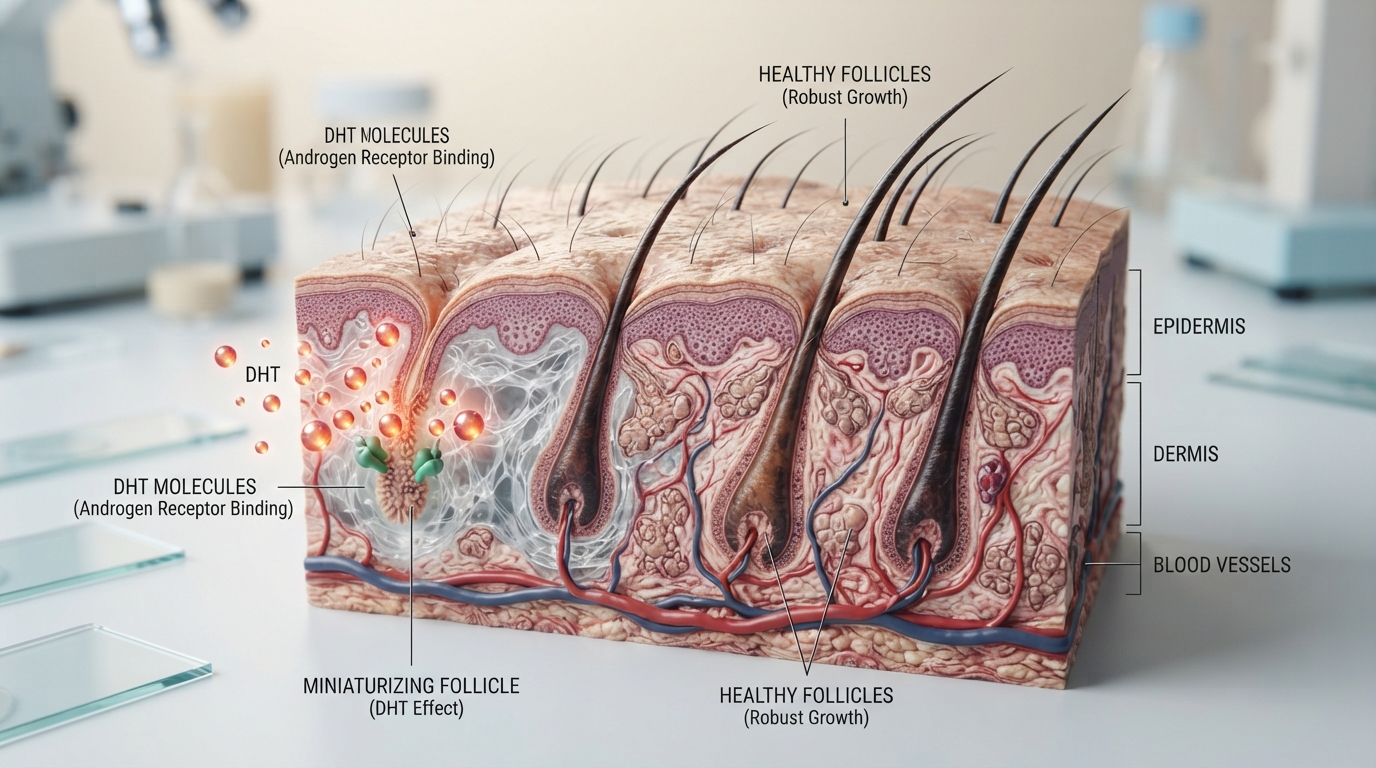
Hair loss is common, often distressing, and surrounded by a fog of marketing claims. The good news is that for the most common form—male pattern hair loss, or androgenetic alopecia—there are treatments with real evidence behind them. This article reviews what the research supports and what remains experimental.
This article is educational and not medical advice. Hair loss can have many causes; a proper diagnosis from a licensed healthcare professional should come before any treatment.
What Causes Pattern Hair Loss
Androgenetic alopecia is driven by genetics and hormones—specifically dihydrotestosterone (DHT), a derivative of testosterone. In genetically susceptible follicles, DHT causes miniaturization: hairs grow shorter, thinner, and lighter over successive cycles until the follicle stops producing visible hair.1
Finasteride: Targeting the Root Cause
Finasteride is an oral medication that inhibits 5-alpha-reductase, the enzyme that converts testosterone to DHT. By lowering DHT, it addresses the hormonal driver of pattern hair loss. Clinical trials show it halts progression in a majority of men and can produce regrowth, with benefits accruing over months to years.2
Known side effects include reduced libido, erectile dysfunction, and ejaculatory changes in a small percentage of users; these typically resolve after stopping, though persistent symptoms have been reported and remain an area of ongoing study.2 Finasteride is contraindicated in pregnancy due to risk to a male fetus, and women who are or may become pregnant should not handle crushed tablets.
Minoxidil: Stimulating the Follicle
Minoxidil is a topical treatment (and, increasingly, a low-dose oral option) that appears to work by increasing blood flow and extending the hair follicle's growth (anagen) phase. It does not block DHT, so it's often used alongside finasteride rather than as a substitute.3
Results take time—typically 3–6 months—and continued use is required to maintain any benefit; stopping leads to reversal. Topical minoxidil is generally well tolerated, with scalp irritation the most common issue. Low-dose oral minoxidil is prescribed off-label by some clinicians and carries its own considerations, including potential hair growth in unwanted areas and effects on heart rate or fluid retention.4
Combination Therapy
Because finasteride and minoxidil act on different parts of the hair-loss process, they are frequently combined. Several studies and clinical experience support that combination therapy can outperform either agent alone for suitable candidates.5
Emerging and Adjunct Options
Dutasteride
Dutasteride is a more potent 5-alpha-reductase inhibitor that blocks both type I and type II isoforms of the enzyme. Some evidence suggests it may be more effective than finasteride, though it is not FDA-approved for hair loss in the U.S. and is used off-label.6
Low-level laser therapy (LLLT)
LLLT devices (combs, caps) have shown modest evidence for improving hair density and are generally low-risk, though results vary and adherence matters.7
Ketoconazole shampoo
Often used for dandruff, ketoconazole shampoo has mild anti-androgen effects and is sometimes added as an adjunct, though evidence is weaker than for finasteride or minoxidil.
Platelet-rich plasma (PRP) and transplantation
PRP injections have mixed evidence and are not consistently recommended in major guidelines. Hair transplantation—relocating DHT-resistant follicles—remains the most durable option for established loss but is surgical and costly.
Setting Realistic Expectations
- Timeline: 3–6 months to see effects; full benefit often at 12–24 months.
- Maintenance: Most medical treatments require ongoing use to retain results.
- Variability: Response differs by individual, age, and extent of loss.
The Bottom Line
For androgenetic alopecia, finasteride and minoxidil remain the best-evidenced medical options, and they work well together for many people. Newer and adjunct approaches can help but should not replace a proper diagnosis. Probably fine. Better to know—then talk to a provider about what fits your situation.
Sources & Citations
- Kaufman KD. Androgens and alopecia. Molecular and Cellular Endocrinology, 2002.
- Finasteride Male Pattern Hair Loss Study Group. Long-term (5-year) multinational experience with finasteride 1 mg. European Journal of Dermatology, 2004.
- Olsen EA, et al. Topical minoxidil in male pattern hair loss. Journal of the American Academy of Dermatology, clinical trial literature.
- Sinclair R, et al. Low-dose oral minoxidil for male androgenetic alopecia. Journal of the European Academy of Dermatology and Venereology, clinical reports.
- Chandrashekar BS, et al. Efficacy and safety of topical minoxidil and finasteride combination. Journal of Cutaneous and Aesthetic Surgery, 2015.
- Gubelin H, et al. Dutasteride vs finasteride for treatment of male pattern hair loss. Journal of the American Academy of Dermatology, 2014.
- Avram MR, Rogers N. Low-level laser therapy for hair growth. Clinics in Dermatology, 2009.
About the PRBLY Medical Team
PRBLY's editorial content is reviewed by licensed healthcare professionals to ensure medical accuracy, clarity, and balance. Our team breaks down treatments, medications, and health topics in plain language so you can understand your options and make more informed decisions.
This article is for general educational purposes only and does not constitute medical advice, diagnosis, or treatment. Always consult a qualified healthcare provider about your specific situation.